


















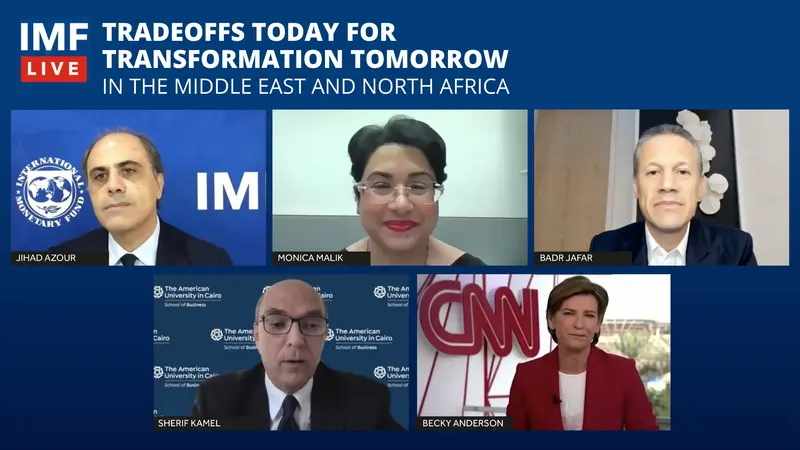
The International Monetary Fund (IMF) hosted an expert discussion on the state of recovery in the Middle East and North Africa (MENA) region, in tandem with the launch of its annual Middle East & Central Asia Regional Economic Outlook report. The report outlines the region’s post-pandemic progress and the policies that can help secure a more sustainable, inclusive recovery.
The discussion, moderated by CNN’s Becky Anderson, brought together Jihad Azour, Director of the Middle East and Central Asia Department at the IMF, Badr Jafar, CEO of Crescent Enterprises, Sherif Kamel, Dean of the American University in Cairo School of Business, and Monica Malek, Chief Economist of Abu Dhabi Commercial Bank.
Several countries across the region, primarily in the Gulf Region, have made significant strides, but progress has been inconsistent. Jihad Azour explained, “Since the beginning of this year, the MENA region has made good progress and the recovery is ongoing despite the new outbreaks. Yet, the recovery is uneven and incomplete, with new challenges emerging, such as rising inflation and inequities. Countries with higher vaccination rates, less dependence on tourism, and more policy space will recover more quickly and experience less scarring in the longer term. Oil exporters will benefit from higher oil prices.”
Although vaccine roll out has advanced rapidly in the GCC and some other countries, the region as a whole has only received 8 percent of global administered doses, despite it making up 14 percent of the global population. The disproportionate impact of the pandemic is most evident among young people, women, and migrant workers, as well as among smaller businesses. According to the IMF report, 34% percent of SMEs – which faced the largest declines in sales – received at least one form of policy support, compared with 48 percent of large firms.
Despite several challenges emerging as the region recovers from the pandemic, Badr Jafar shared his views on some positive trends unfolding in the private sector. Alongside a record rise in venture capital investments, and a conscious shift towards embracing Environmental Social Governance (ESG) principles in business, Badr Jafar emphasised, “As trust in business globally rises, I’m seeing a similar trend in our region, with the private sector increasingly seen as an essential partner to achieve our region’s national goals.”
The pandemic has made it increasingly clear that governments around the world cannot overcome economic shocks and emerging challenges alone. Badr Jafar remarked, “In many ways, the pandemic forced sectors to work together around the world. The vaccine drive is a clear example of a successful public, private, and people partnership. And so I hope that the experiences of the past 18 months will provide inspiration as to the models of collaboration and cooperation we need to see in the region if we are to overcome our most difficult challenges.”
Business must be part of the solution, and the IMF’s report highlights that a key requirement for a transformational recovery of the region is a reorientation of the role of the state with a focus on health, education, providing social safety nets, and pursuing competition-enhancing regulatory reform to promoting private sector innovation and growth.
Among the several policy recommendations put forth by the IMF’s REO, is the careful calibration of financial policies. Depending on the strength of the economic recovery and the scope of policy support, the report suggests that 15 to 25 percent of firms in the region may need to be either restructured or liquidated. Therefore, a gradual withdrawal of financial sector support remains key to preventing defaults that would harm private sector recovery, employment, and financial stability.
In addition to technical support and policy advice, the IMF has supported its members in the region with USD 20 billion in financing since the pandemic began and allocated Special Drawing Rights of USD 49.3 billion that supplement the region’s reserve assets, which will help countries manage policy difficult trade-offs.
Ultimately, many countries will face difficult policy tradeoffs as they navigate their post-pandemic recovery. However, improved policies and forward-looking investments have the potential to lead to a transformational recovery, and a more sustainable, resilient, and inclusive future for the region.