



















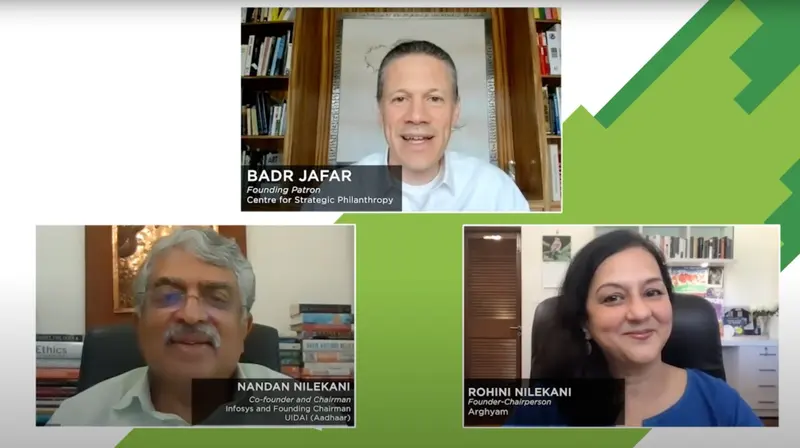
In an insightful conversation with Badr Jafar, Founding Patron of the Centre for Strategic Philanthropy at Cambridge University, renowned philanthropists Nandan and Rohini Nilekani shared their perspectives on the changing nature of strategic philanthropy, in the context of their own philanthropic initiatives, as well as in India at large.
Nandan Nilekani, Co-Founder of Infosys, shared, “Some of the philosophies that underpin our work give people the opportunity to contribute to the local economy. Whether that be through access to education or to clean water, our main goal is to give as many people as possible access to a secure financial future.” This is particularly important in the wake of the COVID-19 pandemic, he reflected, which has undone many of the gains made over past years.
Rohini Nilekani, Founder and Chairperson of Arghyam, a foundation established to support sustainable water and sanitation solutions across India, binds her diverse philanthropic initiatives with one common thread: Samaaj, or society. She outlined the crucial role that cross-sector collaboration plays in strengthening society, “It is patently obvious to all of us that you cannot solve issues in silos. If you’re interested in having impact at the scale of the problem, then you have to work with the state, markets, and society.”
Badr Jafar expressed similar sentiments, noting that the possible silver lining of the COVID-19 pandemic is the strategic partnerships formed, with over $20.2 billion in funding deployed globally from corporations, foundations, public charities, and individuals, all working together to address the pandemic.
Rohini Nilekani added that the pandemic revealed truths that could have major effects on the practice of philanthropy. Namely, it confirmed that private philanthropists have the unique ability to take risks and innovate during global crises, that civil society is the true first responder, and that digital technology has a transformational part to play in overcoming current and future challenges.
Nandan Nilekani highlighted technology’s ability to enable scale and speed, and to create a common platform to combat the diverse challenges our world faces. While there are dangers to technology, Rohini Nilekani asserted, “Good technologies will amplify good intent, and we have to use them.” In 2015, Nandan and Rohini Nilekani co-founded the EkStep Foundation to address the lack of access to learning opportunities in India through an open digital infrastructure. With approximately 20 million children entering and exiting the education system in India each year, according to EkStep, the large scale of reach enabled by technology is vital to achieving impact. In just over five years, the Foundation has enabled millions of children across India to improve their literacy and numeracy skills.
According to the World Bank, India’s economy is expected to grow by 8.3 per cent this fiscal year, making it the second fastest-growing economy in the world. Ultimately, with the fastest-growing economies worldwide belonging to emerging markets, and an undeniable rise in philanthropic commitments within and from those markets, the trio underscored the profound need and opportunity to push the momentum forward towards maximum and sustainable impact.
The conversation between Nandan Nilekani, Rohini Nilekani, and Badr Jafar is part of The Business of Philanthropy, a series of discussions hosted by the Centre for Strategic Philanthropy at the University of Cambridge, to explore the changing nature of charitable giving across the world’s growth markets and to find new ways in which the sector can maximise its impact.