AMSTERDAM - In Lebanon, private hospitals account for 80% of healthcare services, according to the Ministry of Health. Due to the unprecedented economic crisis, an estimated 40% of medical professionals, including around 2,000 nurses, have left the country and many hospital departments are being forced to close.
“We come close to a great collapse,” said Minister of Public Health, Firass Abiad, speaking to Reuters at the start of 2022. While the healthcare exodus continues, ongoing internal issues especially the COVID-19 pandemic have increased the workload of the understaffed hospitals in Lebanon.
42 Syrian and Lebanese nurses graduated
To address the urgent staff shortages, a program by SPARK, an international non-governmental organization (INGO), financed by the Islamic Development Bank (IsDB) and Islamic Solidarity Fund for Development (ISFD), through the Tadamon programme, is training both Syrian and Lebanese youth in medical skills.
By cooperating with CIS College in Beirut, a private higher education institution, 42 Syrian and Lebanese nurses have qualified since July 2021 from a special, intensive curriculum developed by doctors and local healthcare institutions.
“I wanted to become a doctor, or to help a doctor”
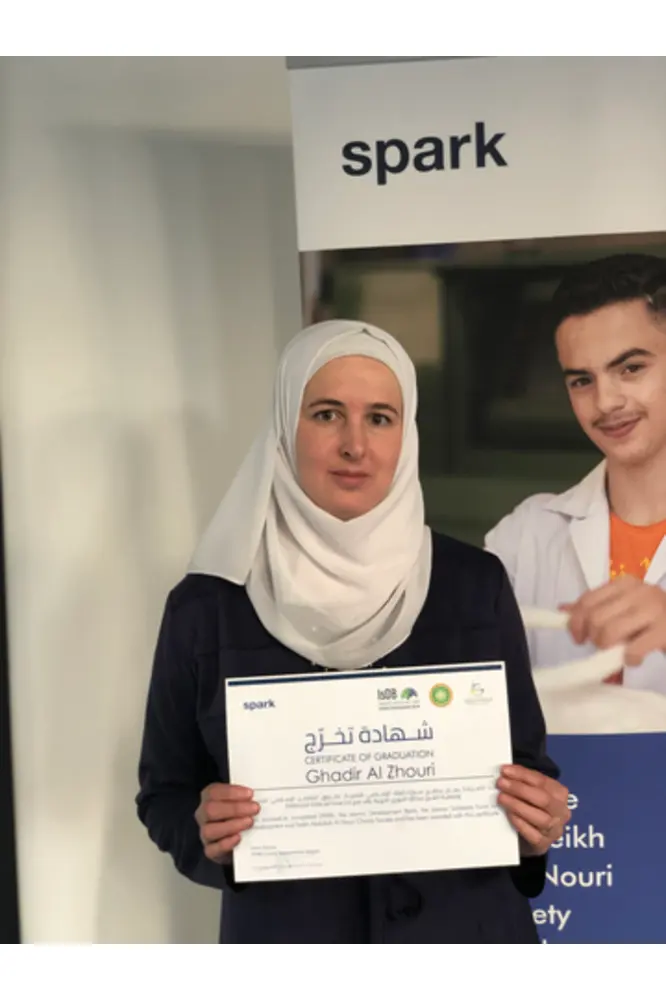
Ghadir Al-Zouhouri had to leave everything behind, including her studies, when she left Syria for Lebanon. She decided to study the intensive nursing course in order to obtain a degree that will allow her to work. Ghadir says: “I’ve always wanted to cure people, either as a doctor or a nurse.” As a young nurse, Ghadir is happy to achieve her dreams and wishes to further continue her education.
Mayas is proud of saving lives
“I came from Syria to Lebanon when there was only one month left to complete my studies,” says young Mayas Al-Hassoun. She couldn’t get a chance to complete her studies for five years until she learnt of the intensive courses offered by SPARK and its local partners. Having graduated from Kairouan Institute, in the Bekaa region, she interned as a nurse in Al Rahman hospital. “I’m proud of saving lives,” she says.