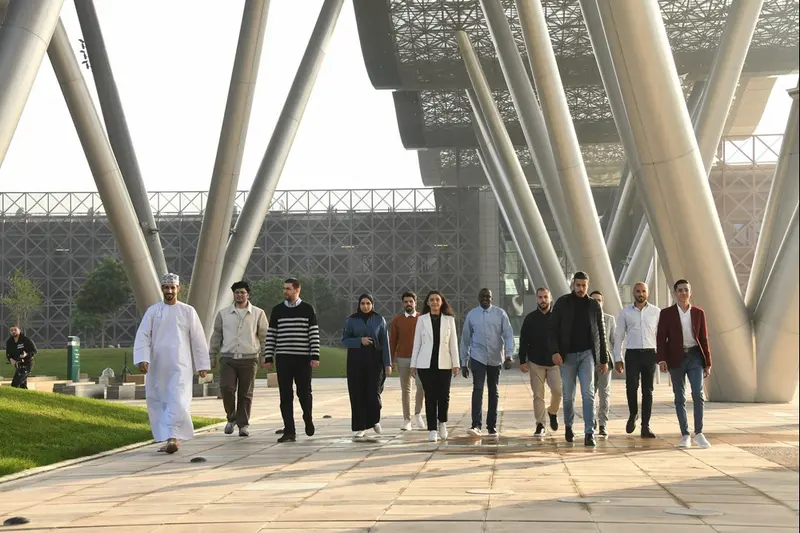
Doha, Qatar — Almost 60% of the Arab world’s population is made up of people under 25 years of age, making it the most youthful region globally. The potential, capabilities and promise that this demography holds for scientific innovation are being explored through another new season of Stars of Science, whose studios in Qatar Science & Technology Park came alive as the first round of auditions kickstarted its milestone season 15.
A platform for showcasing regional talent and innovation, Qatar Foundation’s (QF) long-standing edutainment show will see Stars of Science participants develop their solutions with the support of mentors and an experienced team, progressing through several elimination rounds to secure a spot in the Grand Final, where two winners will each be awarded a share of the prize in seed funding.
Prof. Fouad Mrad, STI Consultant and long-time juror on Stars of Science, commented on the cultural impact Stars of Science has on the Arab entrepreneurial ecosystem: “The show incentivizes people not to settle on reading books and have award certificates hanging on the walls,” he said. “We need to become productive individuals who innovate, enjoy the entrepreneurial journey, and drive transformation in creating jobs for others instead of pleading for one.”
Yosouf Al Salehi, the Executive Director of Qatar Science & Technology Park – also a member of QF – and a previous juror on Stars of Science, believes the show’s success lies in its ability to provide accessibility and de-mystifying science, which is crucial in mobilizing the next generation of Arab innovators. “The region as a whole has made significant strides in digital infrastructure and sustainable development over the years,” he said.
“However, there still remains a lot to tackle in terms of promoting entrepreneurship, encouraging risk-taking, and raising awareness of technology-driven solutions. In this context, Stars of Science has done a fantastic job in bridging the knowledge gap and breaking down the cultural barriers to achieving that mindset.”
Stars of Science aims not only to drive innovation, but to also create an entrepreneurial ecosystem that helps foster innovation-driven economies and develop a highly skilled workforce in the science and technology fields. The Middle East has witnessed a simultaneous rise in tech start-ups and entrepreneurship, particularly in sectors like fintech, e-commerce, health tech, and renewable energy. According to a Forbes report, tech startups in the Middle East attracted a record-breaking $3.94 billion in funding in 2022, a 24% jump in value from 2021.
The Stars of Science alumni community, with 161 members across 18 Arab countries, illustrates the show's influence in the region. In the last 15 years the show has launched over 55 alumni into entrepreneurial ventures, navigating product and business development, investors funding, and strategic partnerships. Notable winners and finalists have demonstrated the boundless power of innovation across diverse sectors.
Season 2 finalist, Ahmad Al Ghazi, from Saudi Arabia invented a motorized walker for the elderly. His flagship product ‘Can-Go’, the world’s smartest walking cane, was launched in May 2022 from his Silicon Valley firm, Can Mobilities.
In food tech, season 4 winner Khalid Aboujassoum – also the first Qatari winner of Stars of Science – introduced ‘Oliver’, a smart cooking appliance, and more recently ‘The Oliver fleet’, a “set-it-and-forget-it” autonomous cooking solution for commercial kitchens of all types and sizes.
After her participation in Stars of Science Season 10, Dr. Nour Majbour, from Syria, emerged as a symbol of female empowerment in the Arab world, inspiring women to pursue a future in STEM. She registered her project QABY, a research kit designed to diagnose Parkinson’s disease in its early stages through antibodies, as a trademark with QF. She is now serving as a Transitional Biomarkers Senior Scientist at AstraZeneca, UK.Stars of Science will air every Friday and Saturday from 8 September, 2023 to 20 October, 2023, on 5 channels in the region and online.