











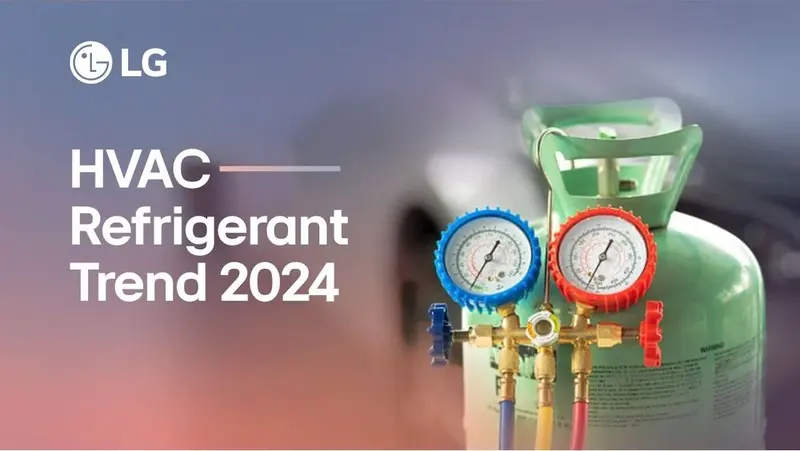
Dubai, United Arab Emirates — With the environmental impact of refrigerants continuing to being a growing concern, experts at LG have identified key trends in the industry as it undergoes major transformations. The purpose behind this research is to ensure that technicians and consultants in the HVAC industry have a thorough understanding and be well prepared for the new era of refrigerants.
As a technology brand overall, LG is committed to providing sustainable solutions. In this context, LG has been actively working towards future proofing in a way that aligns with the brand’s ESG commitments. This has resulted in the development of technologies such as heat exchangers designed to reduce refrigerant volume and the engineering of systems that consider the unique cycle characteristics of each alternative refrigerant.
New Global Standards
On a global scale, the European Union’s F-Gas Regulation, a true commitment to environmental protection, seeks to curtail the use of Hydrofluorocarbons (HFCs) by 95% by 2030 compared to 2015, going down to zero by 2050. As part of this goal, starting from 2027, plug-in and other self-contained systems under capacity 50kW will be prohibited from using F-gases with a Global Warm Potential (GWP) of 150 or more. Additionally, single-split systems containing less than 3 kilograms of F-gases with a GWP of 750 or more will be banned in 2025. Additionally, North America’s EPA’s (Environmental Protection Agency) SNAP (Significant New Alternative Policy) program set forth clear guidelines to phase out ozone-depleting substances. The EPA is mandated to reduce the production and usage of HFCs by 85% by 2036.
The Next-Generation Refrigerants
This begs the question, what is the ideal refrigerant to go for? Experts at LG have deduced three main categories, which have lower GWP overall. The first option is to use Hydrofluorocarbons (HFCs), and hydrocarbons (HCs), which offer various benefits such as enhanced efficiency, reduced GWP and recyclability along with advantages in environmental impact and safety.
Another option is to use Hydrofluoroolefins (HFOs), which are is a new, more sustainable alternative for refrigerants. These compounds are often blended with other substances, resulting in a much lower global warming potential than traditional HFCs. For example, R454B, commonly known as Opteon™ XL41, is a pivotal refrigerant in the HVAC industry, with a lower Global Warming Potential (GWP) when compared to the more commonly used R410A.
However, the best option comes in the form of Natural refrigerants. These substances, such as CO2 (R744), ammonia (R717), and hydrocarbons such as propane (R290) and isobutane (R600a) have minimal GWP, which makes them the ideal candidates for future HVAC systems.
Staying Ahead
As this transition takes place, notable changes will occur. For instance, the increasing adoption of refrigerants with lower GWP will require the implementation of new systems or the replacement of existing systems, which can be an additional cost for organizations.
This is where LG’s leadership in HVAC comes into play. LG’s solutions adopt more efficient refrigerants with superior performance and more importantly, lower GWP. Be it in air cooling solutions or even hot water solutions, LG’s strategic transitions comply with regional regulations but also sets a new benchmark for sustainability and efficiency in the HVAC industry.
With this industry-wide change towards environmentally conscious alternatives, the adoption of the right refrigerant will soon become a cornerstone towards championing a sustainable future for generations to come, a goal that LG is eagerly working towards.