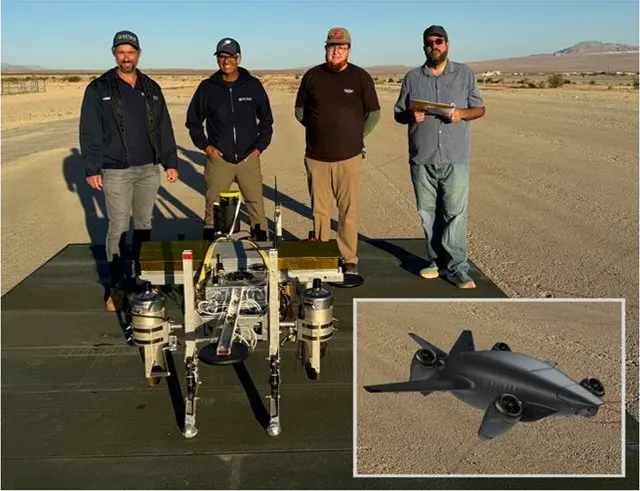
Mayman Aerospace, supported by Edge Group/SDF from the UAE, has successfully conducted flight tests of its RAZOR VTOL test bed at a military facility in Southern California. This test bed replicates the dimensions and weight of the RAZOR P100 and employs the same propulsion, engine gimballing, thrust vectoring, and flight control technologies.
Funded in part by the U.S. Department of Defense, these fully autonomous flight tests aimed to validate key systems including avionics, thrust vectoring, flight control laws, software, and command and control (C2) mechanisms. A significant aspect of this testing series focused on transitioning engines from hover to high-speed winged flight—an essential capability for operational success. These tests also reinforced our track record of successful autonomous take-offs and landings.
The RAZOR VTOL aircraft is designed for versatile applications. Its innovative control system allows for the rapid and secure transport of critical supplies, bolstering military readiness in demanding environments. Additionally, the RAZOR can be modified to extend the operational range of small Air-to-Air or Air-to-Surface missiles like Brimstone and Hellfire, enabling precision strikes over distances exceeding 200 miles.
Launched vertically without the need for specialized launch systems or infrastructure, RAZOR can function as an ISR platform, target designator, and missile delivery system. Its high-speed capabilities facilitate the swift interception of drones, presenting a cost-efficient alternative to traditional cruise missiles. Featuring agile, AI-driven C2/C3 systems, RAZOR guarantees accurate payload delivery at a fraction of conventional costs.
The RAZOR UAS transforms battlefield intelligence collection, offering rapid and adaptable data acquisition. Its VTOL capability allows deployment in constrained areas, and with projected speeds of up to 500 mph, it is equipped with advanced surveillance technology that ensures superior image quality via large gimbaled sensors operating at high altitudes. As an independent platform, RAZOR provides immediate and reliable intelligence, enhancing decision-making in modern warfare.
David Mayman, Founder and CEO of Mayman Aerospace, stated, "Our recent flight tests were a complete success, and we anticipate the P100 will surpass speeds of 450 knots. As a multi-role, dual-use technology, RAZOR is redefining the perspectives of defense commanders and civilian leaders regarding autonomous VTOL applications. We are a software-driven hardware company, and our team is achieving performance levels previously thought unattainable."
Chief Engineer Dr. Manu Sharma noted, "During these tests, we executed seven autonomous mission sets, with all systems operating flawlessly. A key objective was to validate recent updates to our flight software and control laws, especially the transition from hover mode with outward-canted engines to coordinated winged flight. This transition is critical for our operational capabilities, and accumulating more autonomous flight time during take-offs and landings further strengthens our confidence in the system."
These flight tests signify a notable progression for Mayman Aerospace, with additional test flights planned for later this year.