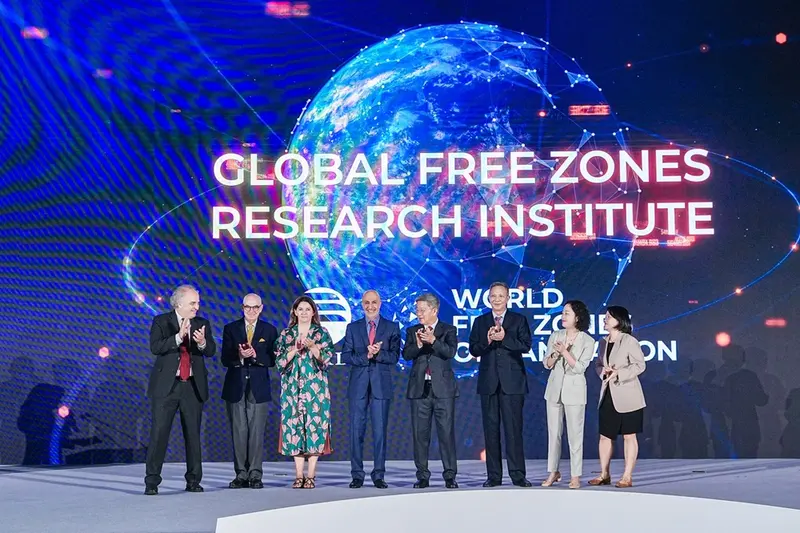
The World Free Zones Organization’s 11th annual World Congress continued its agenda today with a focus on the role of digitization and sustainability in the future of free zones and the mechanisms for enhancing their position as strategic trade gateways.
The day’s sessions featured a series of sessions addressing critical themes such as the digitization of trade corridors, the impact of the OECD Global Minimum Tax, and the role of free zones as regional trade gateways.
Sustainability took centre stage with sessions focusing on the transition to net-zero through renewable energy, circular economy models, and green financing frameworks. Speakers underscored that decarbonization is not only a climate imperative but also a competitive advantage for the next generation of free zones.
The Congress also witnessed the inauguration of the Global Free Zones Research Institute, a pioneering international think tank dedicated to advancing research, policy dialogue, and capacity-building for free zones worldwide.
The Institute’s activities will include conducting research on critical issues facing free zones, providing policy recommendations, organizing expert panels and international exchanges, publishing industry reports, and offering specialised training and consulting services to governments and free zone authorities.
The second day of the Congress witnessed the signing of a Memorandum of Understanding (MoU) between six free zones and five economic and technology zones in Hainan Province. The agreement aims to enhance cooperation in cross-border data flows and strengthen the position of the signatories as key hubs in the global digital economy.
The signatories on the free zone side included the Dubai Integrated Economic Zones Authority (DIEZ) from the United Arab Emirates, PIROT Free Zone from Serbia, Tatu City Free Zone from Kenya, Luanda Special Economic Zone from Angola, Santa Fiesta Free Zone from Argentina, and the General Authority for Investment and Free Zones (GAFI) from Egypt.
From Hainan Province, the signatories included Haikou Jiangdong New Area, Haikou Fosing Industrial Internet Park, Hainan Resort Software Community, Sanya Yazhou Bay Science and Technology City, and Overseas Returnees Town Lingshui.
The MoU establishes a framework for cooperation on cross-border data flows through the development of joint mechanisms that ensure data security and resilience while facilitating the smooth and secure transfer of information between the signatories.