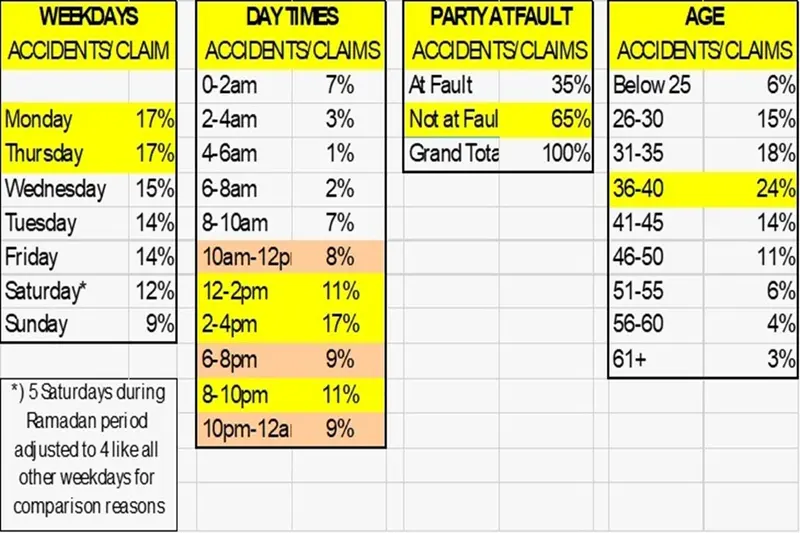
- 2,771 claims data analyzed from last year’s Ramadan period (2025)
- Peak accident day times are 12noon to 6pm, followed by 6pm to midnight
- 2pm-4pm is the most accident-prone 2 hours period
- Mondays and Thursdays show highest rate of accidents
- Drivers aged 36-40 are most at risk
- 65% third party at fault, 35% own fault
- RoadSafetyUAE provides specific Ramadan safe driving ‘Tips & Tricks’
During the holy month of Ramadan, it is sad to witness hundreds of accidents and dozens of fatalities every year. Ramadan is a very special time and it is all about being with the ones close to you, which creates a lot of traffic! This festive time also brings unique challenges for all traffic participants.
Al Wathba Insurance, one of the largest UAE auto insurers teamed up with RoadSafetyUAE to analyze their 2025 Ramadan motor insurance claims data (1st to 29st March 2025) to come up with meaningful insights aimed at raising awareness and protecting UAE road users.
Muralikrishnan Raman, Chief Financial Officer, Al Wathba Insurance states: “We collect a significant amount of claims data which we thoroughly analyze and we want to share the key findings for the good of the people and society in the UAE. In this instance, we analyzed 2,771 UAE claims data. The Ramadan period poses a specific challenge to UAE road users, and we want to contribute from our side to keep everyone safe on the roads. Al Wathba Insurance is in a great position to share real-life data benefitting UAE road users.”
Thomas Edelmann, Founder & Managing Director of RoadSafetyUAE states: “It was amazing to team up with the Team at Al Wathba Insurance to jointly analyze their claims data. UAE motorists need to be especially careful with regards to the behavior of other drivers in Ramadan, as in more than 65% of accidents a third party is at fault. Motorists must watch out in the key accident day times pre-Iftar between 12noon and 6pm (43%), followed by the post-Iftar / Suhoor period between 6pm and midnight (28%). The most accident-prone 2-hours period is between 2pm and 4pm (17%). Mondays and Thursdays (17% each) were the most dangerous week days, while Sundays (9%) were the safest. Drivers aged 36-40 (24%) are most at risk.”
The Ramadan specific lifestyle has physical effects on our body. Fasting can result in dehydration and low blood sugar, which in turn can affect our attentiveness, concentration, vision and reaction.
In addition to fasting, the often unusual and irregular meal timings and sleep patterns can cause fatigue, exhaustion, impatience and distraction, which is reflected in early morning accident peaks.
Hence, ALL traffic participants (motorists, pedestrians, motorcycle riders, bicyclists, etc.) must be extra careful in this time!
How to do it right:
- Be aware of your own potential limitations!
- Watch out for other traffic participants potentially under the same effects.
- Expect the unexpected – we all MUST drive defensively!
- Plan for possible delays and add a time buffer!
- Always wear your seat belt – Ramadan is a good time to finally start this habit!
- Watch out in the time period between noon and Iftar time!
- Try to anticipate sudden movements of other road users.
- Keep a sufficient distance and do not tailgate.
- Plan your schedules properly and leave early to avoid the need of rushing and speeding.
- You can run a little bit late – people will understand.
- Stay off the roads at sundown, if you can avoid it.
- Use your lights during dusk, before Iftar
- Avoid fatigue and get enough sleep.
- Pull over immediately when you becoming drowsy.
- Use public transport or taxis.
How to do it right – as non-fasting driver, pedestrian, motorcyclist, passenger, etc.
- Be considerate and generous to other traffic participants who might fast!
- ALL traffic participants – fasting and non-fasting – must be extra careful during Ramadan!
- Especially, ‘weaker’ traffic participants (pedestrian, cyclist, eScooter rider or motorcyclist) must watch out for potentially irrational behavior of other traffic participants!
- Apply the same defensive driving approach like fasting traffic participants.
- Be very careful in the peak accident morning rush hours and around noon and early afternoon!
- Try to stay off the roads if possible!