


















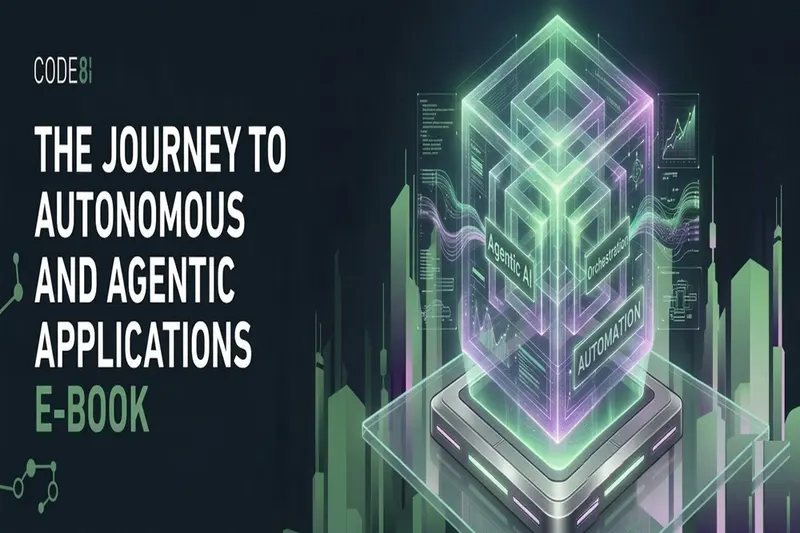
CODE81, an agile, AI-driven digital transformation firm and Ghobash Group Enterprise, announced the launch of its new e-book, The Journey to Autonomous and Agentic Applications, as AI Agents and Agentic AI move from concept into early enterprise use globally. Designed to support concrete decision-making around how and where autonomous and agentic capabilities can be responsibly introduced into core systems, the e-book reflects a broader shift in how intelligent systems are being designed and governed.
The publication outlines CODE81’s perspective on how organizations can move beyond traditional automation toward more adaptive, structurally autonomous applications. It is released amid active enterprise adoption of advanced AI reasoning, AI-driven coding workflows, and autonomous task execution.
Recent advancements in frontier AI models – including Anthropic's Claude Opus and Sonnet, as well as reasoning-capable models from OpenAI and others – are accelerating the shift toward AI-assisted software engineering and agent-based development. Enterprises are now actively exploring how AI Agents can be operationalized within core systems, not as experimental tools but as integral components of modern application architecture.
As enterprises and government entities across the region reach the limits of existing automation, the e-book addresses a critical gap: how applications can be designed to interpret context, coordinate actions, and adapt dynamically – while operating within guardrails that ensure transparency, accountability, and human oversight.
The publication explores how the shift from automation to autonomy is already underway and why AI-assisted development platforms are central to enabling it. These platforms provide the architectural foundation for scalable systems and serve as a control layer that allows autonomy to be introduced in a structured and governed way, particularly in regulated environments.
A central focus of the e-book is the role of AI Agents and Agentic AI in enterprise and government settings – explaining how systems are evolving from tools that execute predefined rules into agents that understand context, interpret intent, and support decision-making within clear governance frameworks. The e-book references emerging agent patterns, including orchestration agents, decision agents, and governance-aware agents designed to operate within policy and compliance boundaries.
The e-book also highlights common reasons why autonomous initiatives fail to scale, particularly in complex and high-impact environments. These include weak architectural foundations, limited business–IT alignment, unclear success metrics, and insufficient governance models.
Commenting on the launch, Nader Paslar, General Manager at CODE81, said: “We are entering a new operating model for the enterprise. AI Agents are no longer experimental concepts. They are becoming embedded into workflows, decision cycles, and customer experiences at scale.
IDC predicts one billion AI Agents globally by 2029. This represents a structural shift in how digital work will be executed. Tools such as Clawd.bot demonstrate how quickly autonomous capabilities are becoming accessible, but accessibility without governance creates risk. The organizations that will lead in this era will not be those that deploy AI Agents first, but those that govern them best. Enterprise-grade security, architectural discipline, and oversight are no longer optional. They are foundational. At CODE81, we see governance not as a constraint, but as an enabler of scalable, trusted AI. That is the foundation this e-book is built on.”
Written for CIOs, CTOs, CDOs, and senior IT decision-makers, The Journey to Autonomous and Agentic Applications combines strategic perspective with practical insight, positioning autonomy as a structural shift in enterprise architecture rather than a short-term productivity initiative. The e-book is now available through CODE81 and forms part of the company's ongoing contribution to modern application delivery.